SQL vs. NoSQL: A Technical Analysis of Database Performance for Enterprise Scalability
The selection between SQL (relational) and NoSQL (non-relational) databases significantly impacts an enterprise application’s performance and scalability profile. This analysis dissects the architectural paradigms, operational characteristics, and empirical performance metrics of both approaches. We examine specific data points to delineate their respective strengths and technical trade-offs in meeting demanding enterprise-grade requirements.
Relational Database Characteristics and Performance Baselines
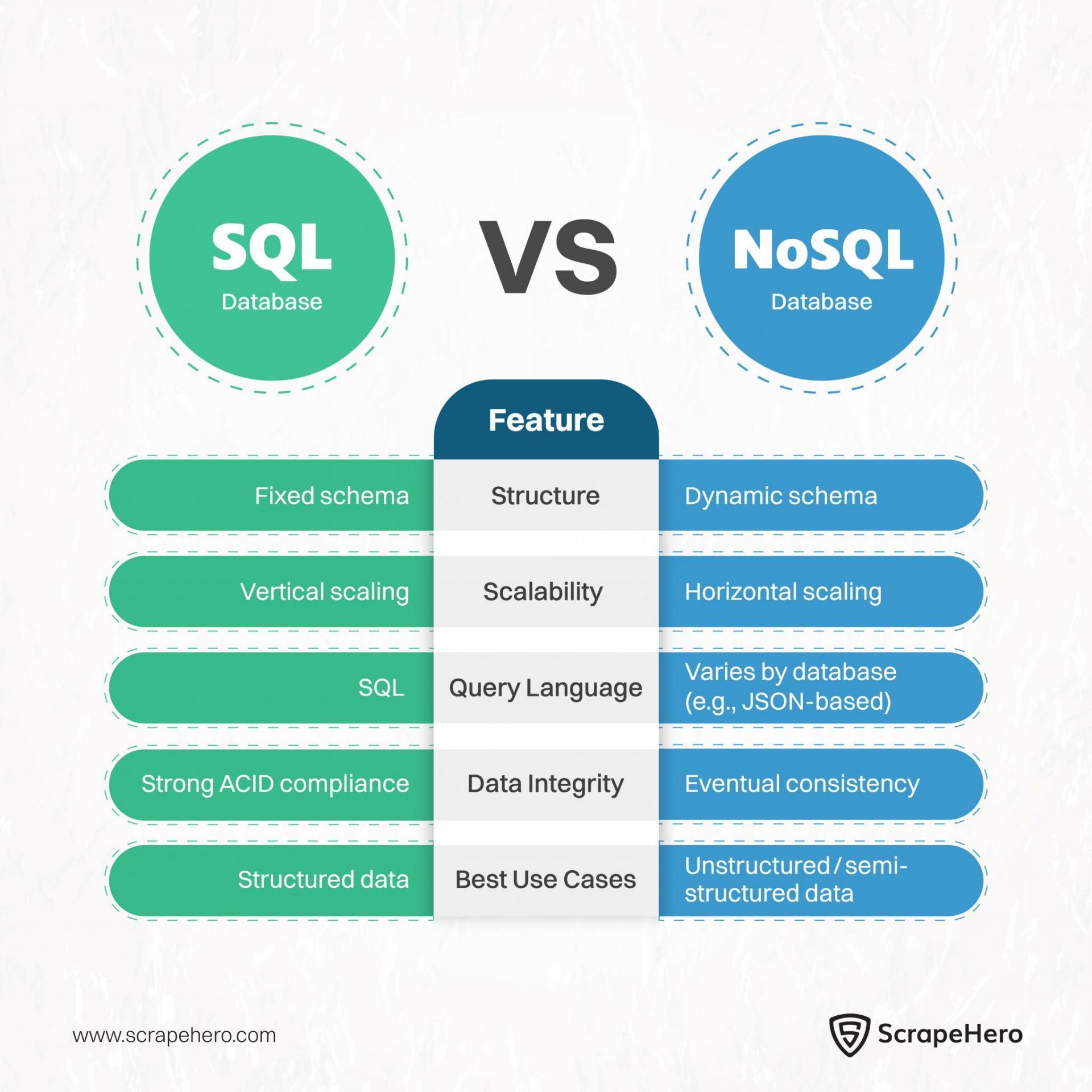
Relational databases, such as PostgreSQL and MySQL, are fundamentally structured around tables with a predefined schema, rigorously adhering to ACID (Atomicity, Consistency, Isolation, Durability) properties. This guarantees data integrity, essential for transactional workloads where multi-step operations must fully commit or roll back. Performance for complex queries involving multiple joins can become a bottleneck as datasets grow.

Benchmarks like TPC-C, simulating OLTP environments, often report 10,000-50,000 Transactions Per Minute (TPM) with average latencies of 5-15ms for simple queries. Complex analytical queries may see latencies of 50-200ms. Scaling primarily involves vertical scaling (upgrading CPU, RAM, storage), which has practical limits. Horizontal scaling via sharding or replication introduces complexity and potential consistency challenges. While read replicas boost read throughput, write operations typically remain on a single primary instance, limiting write scalability to that node’s capacity.
NoSQL Database Characteristics and Scalability Models
NoSQL databases offer diverse data structures (key-value, document, columnar, graph) and flexible schemas, prioritizing horizontal scalability, high availability, and performance for massive datasets. They often align with BASE (Basically Available, Soft state, Eventual consistency) properties. For instance, document databases like MongoDB allow varying fields within documents, facilitating rapid schema evolution.
Different NoSQL types serve distinct use cases. Key-value stores (e.g., Redis, DynamoDB) offer sub-millisecond latency for simple data retrieval. Document databases provide richer query capabilities for semi-structured data, achieving tens to hundreds of thousands of operations per second across a cluster, with 1ms to 10ms latencies. Columnar databases (e.g., Cassandra, HBase) excel at time-series or large analytical datasets, handling millions of writes per second across hundreds of nodes with eventual consistency. Graph databases (e.g., Neo4j) optimize for connected data, where query performance scales with relationships traversed.
Comparative Performance Metrics and Trade-offs
For strong consistency (ACID) and complex relational queries, SQL databases generally outperform NoSQL. A complex analytical query involving five-table joins on a SQL database might complete in 200-500ms. Replicating this in NoSQL could require multiple application-level queries or aggregate views, potentially increasing latency or development complexity for consistency.
Conversely, NoSQL excels in raw write throughput and linear horizontal scalability. A Cassandra cluster can achieve over 1 million writes per second for simple key-value insertions with 99th percentile latencies under 5ms. Scaling a single SQL primary node beyond 50,000 writes per second is significantly challenging and costly. Read performance often favors NoSQL for simple key lookups across large distributed datasets, achieving 1-3ms latencies, compared to potentially higher latencies in SQL systems for similar distributed access patterns if not optimally sharded.
The primary trade-off lies between strong consistency (SQL) and eventual consistency/availability (NoSQL). SQL guarantees all clients see the most up-to-date data. NoSQL often sacrifices immediate consistency for availability and partition tolerance (CAP theorem), with data updates propagating across a cluster with a slight delay (sub-second to several seconds). This impacts application logic: systems needing real-time data accuracy (e.g., banking ledgers) favor SQL, while those tolerant of slight delays (e.g., social media feeds, IoT sensor data) benefit from NoSQL’s scalability.
Architectural Considerations and Use Cases
The choice between SQL and NoSQL is an architectural decision, tied to the application’s data model, consistency needs, and growth projections. For highly structured data, complex relationships, and stringent ACID compliance (e.g., ERP systems, financial trading platforms), SQL databases are preferred. Their mature query optimizers and robust transaction managers provide predictable performance and simplify data integrity. ORM development is also highly standardized.
NoSQL databases suit use cases with massive data volumes, high velocity, schema flexibility, and less rigid consistency. Examples include real-time analytics (e.g., billions of events daily), flexible content management, user profile management in large web applications, and IoT data ingestion. A sensor data platform processing 50,000 readings per second from millions of devices would overwhelm traditional SQL, whereas a columnar NoSQL database could ingest this with ease, partitioning across hundreds of nodes. Operational overhead for distributed NoSQL clusters can be higher, requiring specialized expertise in sharding, replication, and consistency tuning.
Fact/Stat: Over 70% of new enterprise applications leveraging microservices architectures consider NoSQL databases for at least one service, driven by the need for independent scaling and schema flexibility.
Key Insight: NoSQL’s schema flexibility and horizontal scalability align well with the agile development and independent deployment patterns inherent in microservices, enabling faster iteration and reduced inter-service dependencies.
Fact/Stat: A properly indexed SQL database handling 10,000 concurrent users can maintain average query response times below 100ms for OLTP workloads, provided the data model is optimized and the underlying infrastructure is appropriately provisioned.
Key Insight: Despite perceived scalability limitations, SQL databases offer predictable performance and strong consistency for traditional transactional systems, especially when vertically scaled and optimized for specific access patterns.
When is SQL definitively superior to NoSQL for performance?
SQL is superior for performance in scenarios demanding strong transactional consistency (ACID) across multiple related data entities, especially for complex ad-hoc queries with multi-table joins. In banking systems, where transactions must atomically update multiple accounts and ledgers, SQL’s built-in transaction management ensures data integrity and consistency, typically achieving sub-second latency for these operations.
What specific NoSQL database types offer the best scalability for large datasets?
For large datasets requiring extreme horizontal scalability, columnar databases like Apache Cassandra and HBase excel in write-heavy workloads and time-series data, scaling to petabytes with millions of writes per second across hundreds of nodes. Document databases like MongoDB and key-value stores like DynamoDB also offer excellent horizontal scalability for read/write operations on semi-structured or simple data lookups, distributing data across clusters for high throughput and low latency.
How does data modeling impact performance across SQL and NoSQL systems?
Data modeling profoundly impacts performance. In SQL, a normalized data model reduces redundancy but can necessitate complex joins, impacting read performance for highly relational queries. Denormalization or appropriate indexing can mitigate this. In NoSQL, modeling often involves denormalization and aggregation to optimize for specific access patterns, embedding related data within a single document or row to minimize distributed operations. This “query-first” modeling significantly enhances read performance by reducing network hops, but can lead to data redundancy, increased storage, and complex update operations for redundant fields.