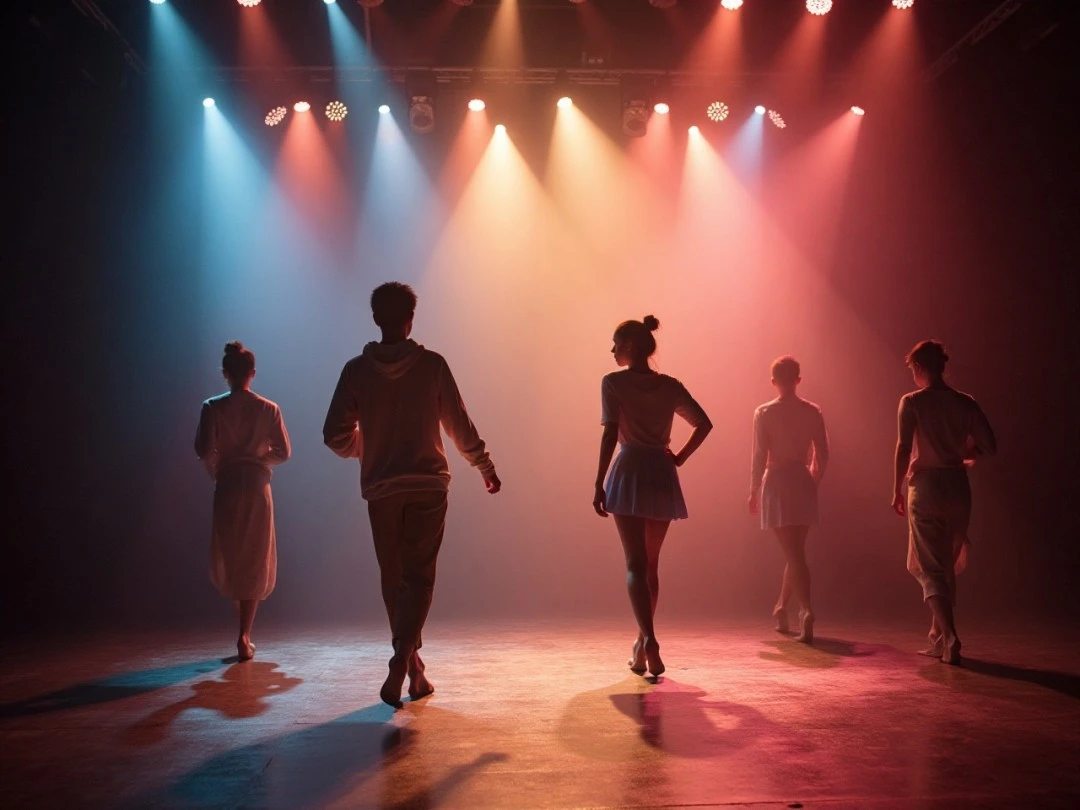
The Evolution of Side Lighting in Dance Performance
Prior to the 20th century, dance lighting predominantly relied on frontal illumination, often resulting in flattened visual planes and diminished three-dimensional form. The strategic deployment of side lighting fundamentally altered this paradigm, introducing a sculptural quality to the human form in motion. This technical innovation, emerging from advancements in electrical lighting, enabled unprecedented artistic expression by dynamically sculpting dancers with light and shadow.
Early Theatrical Illumination and Its Technical Limitations
The theatrical lighting landscape before the widespread adoption of electricity presented significant technical constraints. Early stages utilized natural light, then moved to candle and oil lamps, and later gaslight systems in the 19th century. These sources, while providing illumination, offered limited directional control due to their fixed positions, inherent heat generation, and low lumen output. Footlights, positioned at the stage edge, provided primary illumination from below, often casting distracting shadows upwards and flattening performers’ features. Border lights and proscenium arch lights offered general washes from above and front, respectively, contributing to an overall bright but undifferentiated stage picture. The inherent immobility, slow response time for dimming (often reliant on mechanical valves for gas, or carbon arc lamps requiring manual adjustment), and safety concerns (flammability) made precise focus and angle manipulation impractical. Lumens were low, color control non-existent, and the ability to isolate specific areas or sculpt individual performers was severely restricted. This era prioritized overall visibility rather than nuanced artistic definition, leaving the dancer’s form largely unarticulated by directed light, reinforcing a two-dimensional ‘picture frame’ aesthetic inherent to the proscenium stage.

The Dawn of Directional Control: Sculpting with Light
The advent of electrical lighting in the late 19th and early 20th centuries marked a pivotal shift, ushering in the era of directional control. Innovations such as the incandescent lamp, followed by more efficient optics like the Fresnel lens (developed for lighthouses in 1823, adapted for theatre in the early 20th century) and the ellipsoidal reflector spotlight (ERS), patented in 1933 by Stanley McCandless and others, provided tools for precise beam shaping and focus. This allowed designers to move beyond general illumination. Pioneers like Loïe Fuller explored light’s transformative potential in the 1890s, using colored gels and electric lamps to create dynamic, abstract forms with her flowing costumes. However, it was the integration of these new technologies with evolving choreographic philosophies, particularly in modern dance, that cemented side lighting’s role. Reliable electrical grids and advancements in dimmer technology, evolving from resistance plate dimmers to magnetic amplifier systems in the 1950s, offered unprecedented control over light intensity and transitions.
Key figures such as Jean Rosenthal, collaborating extensively with Martha Graham from the 1930s onwards, revolutionized dance lighting. Graham’s choreography, emphasizing angularity, strong lines, and emotional depth through physical tension, demanded a lighting approach that could articulate the body’s musculature and the negative space around it. Rosenthal deployed instruments on vertical pipes, known as "booms," positioned at the sides of the stage. These fixtures, often focused at acute angles (e.g., 45-60 degrees relative to the stage floor), illuminated dancers from the wings, defining limbs and torsos through highlights and deep shadows. This technique not only emphasized the dancer’s form but also separated them from the background, creating a three-dimensional presence that frontal light could not achieve. The precise control offered by ERS units allowed for sharp beam edges suitable for defined pools of light, while Fresnels provided softer, more diffused sidelight, offering a versatile palette for sculpting different movement qualities.
Technical Advantages and Aesthetic Impact
The adoption of side lighting introduced a suite of technical and aesthetic advantages crucial for dance performance. From a technical standpoint, side-positioned instruments significantly reduce spill onto the stage floor and backdrop compared to overhead or frontal sources, enhancing focus on the performer. By illuminating the dancer from the horizontal axis, side light excels at revealing the contours and musculature of the body. Various angles of side lighting produce distinct effects:
- High-side light: Typically angled 60-75 degrees from horizontal, this emphasizes the top and upper sides of the form, creating strong definitions along shoulders, head, and elevated limbs. It highlights the upper planes, contributing to a sense of uplift or dramatic tension.
- Mid-side light: At approximately 45-60 degrees, this sculpts the entire side of the body, offering a balanced highlight-and-shadow ratio that clearly delineates the body from the background and defines musculature without harshness. This is often a foundational layer for dance.
- Low-side light: Positioned near the stage floor (0-30 degrees), this can dramatically elongate shadows, emphasize the groundedness or elevation of movement, and create stark, often dramatic, outlines. It interacts powerfully with lower body movements and floor work.
The primary aesthetic benefit lies in enhanced depth perception and sculptural quality. Frontal light tends to flatten the dancer against the background, while side light literally carves them out of the space, enhancing the perception of movement through three dimensions. It creates "key" and "fill" lighting on the body itself, with one side illuminated and the other gently shadowed, giving volume and preventing the perception of a two-dimensional cutout. This technique is particularly effective for large group formations, where individual dancers maintain their distinct forms even within a complex tableau. Technical trade-offs include increased instrument count and complex cabling for boom setups, often requiring specific vertical pipe positions (e.g., "trees" or "booms" rigged from the stage floor or fly system) which must be carefully managed to avoid visual obstructions or safety hazards. Power distribution must also accommodate multiple discrete circuits for precise control over individual sidelight instruments, requiring more extensive electrical infrastructure and dimmer channels.
| Lighting Aspect | Traditional Frontal Lighting | Modern Side Lighting |
|---|---|---|
| Depth Perception | Minimally defined; tends to flatten performer against background, reducing perceived volume. | Enhanced; creates strong three-dimensional form and separation from backdrop, articulating space. |
| Form Definition | Lacks distinct highlights and shadows, obscuring musculature and body contours. | Accentuates muscle definition, revealing contours through directed highlights and nuanced shadows. |
| Shadowing | Often casts distracting shadows behind the performer or upward from footlights, creating visual clutter. | Shadows typically fall cleanly to the sides or beneath the performer, contributing to sculptural effect and clean stage lines. |
| Instrument Placement | Primarily FOH (Front of House), border lights, footlights; limited boom use. | Extensive use of vertical boom positions upstage and downstage in the wings, often in multiple parallel pairs. |
| Visual Impact on Movement | Movement can appear two-dimensional; less dynamic interaction with light, reducing kinetic impact. | Movement is articulated and amplified; light dynamically tracks and sculpts the moving form, enhancing kinetic energy. |
| Technical Complexity | Relatively simpler fixture arrangement and focus, fewer instruments required for basic coverage. | Requires more instruments, precise focus, complex boom rigging, extensive cabling, and granular dimmer control. |
"Lighting is painting with light, and what you are painting is space and time. You take the dancers, put them in a moment, and help them move into the next." — Jean Rosenthal, pioneering lighting designer for Martha Graham, encapsulating the philosophy behind sculpting dancers with directional light and defining their presence within the stage environment.
"The critical contribution of side lighting in dance is its capacity to physically articulate the performer within the stage volume. It transcends mere visibility, becoming an active participant in choreographic expression by literally shaping perception, revealing the geometry and emotion of movement." — Richard Pilbrow, influential theatre consultant and lighting designer, emphasizing the aesthetic and structural power of this technique from a global perspective.
FAQ
What specific technical innovations enabled widespread side lighting?
The transition from gaslight to incandescent lamps in the early 20th century provided brighter, more stable, and safer light sources. Crucially, the development of focusing optics like the Fresnel lens and the ellipsoidal reflector spotlight (ERS) allowed designers to shape and control beams with unprecedented precision and intensity. Furthermore, advancements in dimming technology, progressing from cumbersome resistance dimmers to more efficient and responsive electronic systems (thyratron and later SCR dimmers from the 1950s onward), enabled dynamic control over intensity and complex lighting cues, vital for creating nuanced light states for dance.
How does side lighting affect a dancer’s perceived musculature?
Side lighting significantly enhances the perception of a dancer’s musculature by creating a distinct play of highlight and shadow across the body’s contours. When light strikes from the side at angles such as 45-60 degrees, it catches the prominent curves of muscles—like the quadriceps, deltoids, and lats—illuminating one side while leaving the other in a subtle shade. This contrast sculpts the form, emphasizing definition, separation between limbs, and the dynamic tension inherent in movement. This effect is far more pronounced than with frontal light, which flattens contours, or top light, which can cast uniform shadows directly below, obscuring lateral definition.
Are there any disadvantages or challenges with employing side lighting?
Yes, side lighting presents several technical and logistical challenges. It typically requires a higher number of individual lighting instruments compared to general frontal washes, increasing equipment costs, power consumption, and setup complexity. Precise focusing is critical to avoid unwanted spill onto backdrops or into the wings, demanding more setup time and skilled technicians. Boom placement must be carefully managed to ensure clear sightlines for the entire audience and to prevent physical obstruction for dancers moving into or out of the wings. Specialized rigging hardware, such as robust boom bases, pipe clamps, and safety cables, is essential for securely positioning instruments and managing the extensive cable runs required for individual circuiting and control.